-
Bilgi Üniversitesi Açık Günler
İki gündür tüm Uludağ proje ekibi olarak Bilgi Üniversitesi’nde kamp kurmuştuk. Meşhur Pardus Çalışan CD’mizin beta testlerini geçmiş ve hata giderilmiş nihai 1.0 sürümünü dağıttık, çeşitli konuşmacıları dinledik, biz konuştuk, soruları yanıtladık, katkıcılarımız ve destekçilerimizle tanıştık, konuştuk.
4 Mart sabahı sevgili A. Murat Eren hasta hasta Özgür Yazılım Felsefesi konulu bir sunum yaptı, sevgili Doruk Fişek ve Barış Metin‘in katkıları ile. Her ne kadar “Açık Günler’e gelenler nasıl olsa özgür yazılımdan haberdardır” demek mümkün olsa da bence bu tanımları, kavramları ve felsefeyi ne kadar anlatsak az. Sonra kavram kargaşaları oluşuyor açık ile özgür, bedava ile özgür arasında.
Öğleden sonra FSF Europe‘dan Georg Greve’nin harika sunuşu vardı, sanki Murat’ın sunuşunun devam niteliğinde. Gerog’un berrak ve doğrudan anlatımına hayran oldum, bazı slogan ve kavramları kendi sürümlerime eklemeye karar verdim. Özellikle soru-yanıt bölümünde de Icaza – Greve atışması konferansa renk kattı, bence sonunda ayakta kalan Greve oldu. Zamanlama hatamız yüzünden tanışıp konuşma fırsatı bulamadık :-(, artık sanal ortamda inşallah.
İlk akşam Uludağ ekibinin önemli bir kısmı LKD ekibi ile Aksaray Hacı İbrahim Sofrası’na gitmişler, afiyet olsun. Ben başka bir sözüm nedeniyle katılamadım, artık yine bir dahaki sefere.
5 Mart sabahı sevgili Onur Küçük’ün masaüstü ortamları konulu sunuşu vardı; utanç içindeyim, ama yetişemedim 😦 Öğleden sonra Miguel de Icaza konuştu, kısmen izleyebildim; sanırım ilginç bir konulşma imiş. Ama soru-yanıt bölümünde “Merak etmeyin, mono ile sahipli yazılım üretebilirsiniz, özgür olmak zorunda değilsiniz” demesi çok talihsiz bir açıklamaydı. Umarım önümüzdeki haftalarda özgür yazılım üzerine görüşlerimi blog’uma yerleştireceğim, o zaman ayrıntılı olarak girerim bu konuya.
Sonra biz sahne aldık; önce ben ET ve özgür yazılım, Uludağ ve özgür yazılım ve Uludağ ve Pardus konularında konuştum. Sonra sevgili S. Çağlar Onur Uludağ sürüm yönetimini, sonra da sevgili Gürer Özen ÇOMAR’ı anlattı. Oldukça yoğun soruları ekip olarak yanıtlamaya çalıştık. Sevgili Serdar Hoca her soruyu yanıtlamak için çabaladı durdu, biz de süreyi adil bir şekilde dağıtabilmek için.
Proje ekibinin bir kısmı akşamı İstiklal Caddesi’nde Gazeteciler Cemiyeti Lokali’nde tamamladık. Kimimiz cesur davranıp rakı içti, kimimiz muhafazakar (ve belki de kılıbık) olup bira ve şarapla yetindi, kimimiz portakal suyu. Sonrasında sevgili Görkem ve Filiz Çetin de katıldılar aramıza. Yorulmuştuk, evlere dağıldık.
Güzeldi. Gelecek seneye artık binleri göreceğimiz, salonların her oturumda (yalnızca yabancı konuklarımız için değil) hıncahınç dolu olacağı bir etkinlik ümidiyle yuvamıza, Gebze’ye dönüyoruz!
-
Gerilim Altında Uludağ Geliştiricileri
A. Murat Eren’in Uludağ geliştiricilerini doğal ortamlarında ifşa etmesinin ardından aynı takımın biraz daha gerilimli bir zamanda, örneğin Pardus Çalışan CD’nin 1.0 nihai sürümünü hazırlarken, nasıl bir görüntü verdiklerini karilerime göstermek farz oldu.
Buyrun.
Yalnız baştan uyarayım, resimler 640×480 gibi zavallı çözünürlüğe sahip bir cep telefonu ile çekildiler; sanatsal harikalar beklemeyin. Bir de 16 yaşından küçüklerin görmesi uygun olmayan bazı içerik de mevcut, dikkatli olun.
Zaman 15 Şubat’ı 16 Şubat’a bağlayan gece. Yer Uludağ proje ofisi. Görev Pardus Çalışan CD 1.0 beta’yı nihai sürüme çevirmek. Yapılacaklar listesi zaten birkaç gündür elimizde, çalışıyor arkadaşlar. Hesapta 15 Şubat öğleden sonra CD’yi tamamlayıp baskıya göndereceğiz. Olmuyor, akşama kalacağız. Ulaştırmaya haber verip gece servisi ayarlıyoruz, işimiz bitince, büyük olasılıkla da saat 21:00’den önce, ki Desperate Houseviews‘ın çok şamatası yapılan ilk bölümüne yetişebilelim, bizi evlerimize dağıtacak. Gece saat 01:00’e doğru şoför amcayı evine gönderiyoruz, “Sen bari kendini kurtar” diyerekten.
Arada sıkı bir konsol Türkçe yazıtipi sorunu yaşıyoruz, Barış-Çağlar panikte, çözülüyor.
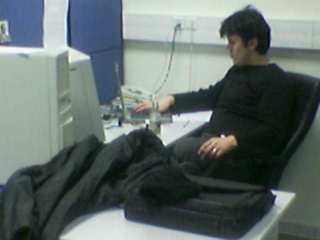
Sonra sıra ÇOMAR’ın grafik ekranı tanıma betiğini geliştirmeye geliyor. Ama ÇOMAR ekibinin bir kısmı beyaz bayrağı çekmiş halde. (hakkını yemeyelim, sabah kafayı kaldırıp “bug mı var, bakalım bakalım, pismillaaa.” diye bir anda girişiverdi işe sevgili Gürer)
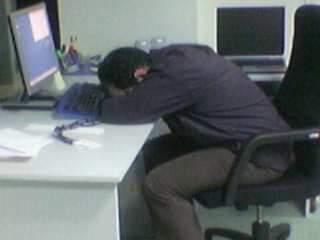
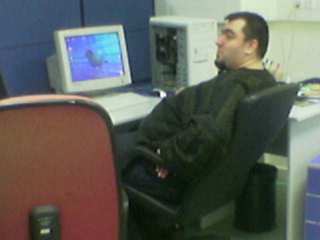
Serdar Hocam betiği öttürmek, en azından ciyaklatmak için tüm yasa ve nizamı çiğneyerek cigarasını tüttürüyor ofiste.
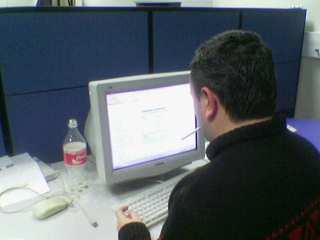
Evet, tanıdınız. O zaten hep oralarda, mizansene gerek yok.
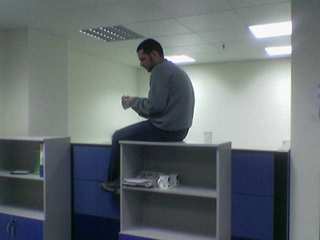
Çalışan CD fabrikamız ofisin en muhkim noktasında pişirilmeye gelecek hammaddeyi bekliyor merakla, ertesi gün öğlene kadar da duruşundan bir gıdım taviz vermedi. Sonraki tüm uykunu hakettin be Onur!
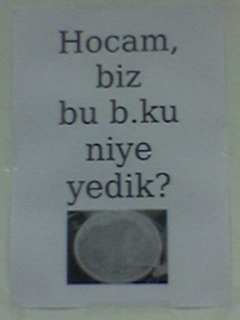
Gece saat 03-04:00 civarı yeni ÇOMAR betiği yerine eskisini kullanmak yönünde önermeler, özellikle proje yöneticisi tarafından, dillendirilmeye başlanıyor. Sürüm sloganına kavuşuyor, meşhur hikaye: “Ağam biz bu b.ku niye yedik?” (bilenler bilmeyenlere anlatsın)
Yavaş yavaş yarıştan kopmalar başlıyor, Çağlar da bu grup içinde.
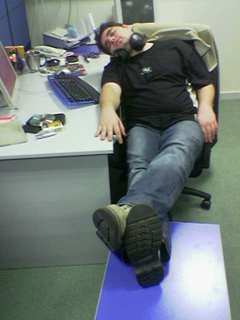
Gürer bir masa ve sandalyeyi olabildiğince muhafazakar kullanarak uyku seti oluşturmada çığır açıyor, ama biz alışkınız bu buluşlara. Bir Pardus ormanda on kaplana bedel.
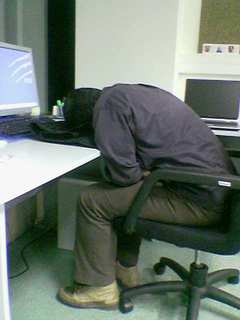
Sürüm yöneticimiz Barış kepenkleri de kapatıyor, artık uygulamalar kesin olarak donduruldu 😉
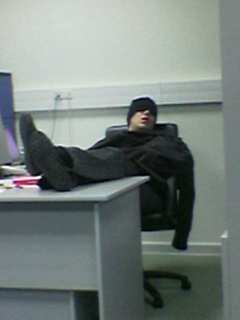
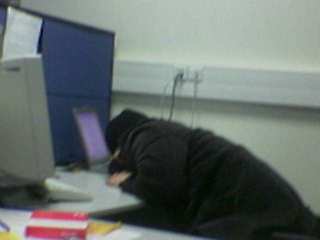
Artık gün ağarmak üzere, Serdar Hoca da pes ediyor.
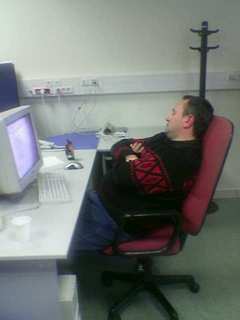
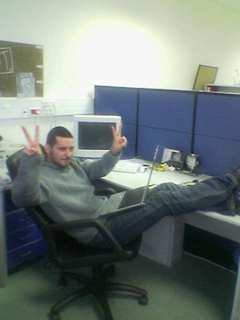
Ve işte sürümün kahramanı: Keçi inadı, maymun enerjisi ve kuzu sevimliliğiyle kameralarımıza gülümsüyor. Bir iki tökezleme hariç hep ayaktaydı, ittirdi, kaktırdı ve sonunda ÇOMAR’ı yeni betiği ile nihai 1.0’a koyabildik. Teşekkürler MEren, seni seviyoruz.
-
Pardus Çalışan CD
Uludağ projesi Eylül 2004 ortasından itibaren yeni bir yola girdi, Ekim 2004 başından itibaren de bu yönde yol katetmeye başladı. Dört ay gibi bir zamanda ilk ürünümüzü çıkardık: Pardus Ulusal İşletim Sistemi Çalışan CD. Ayrıntısı web sitemizde, ilgilisi oraya baksın, ben başka şeyler anlatacağım!

17 Eylül’den bu yana web günlüğümde Uludağ projesi ile ilgili olarak yalnızca Uludağ Barometresi’ni yayınlıyordum. 13 Eylül’de Başarı İhtimali %12, Hayatta Kalma İhtimali de %21 imiş proje için. En son 1 Şubat’ta, yani Pardus Çalışan CD’yi baskıya verdikten sonra güncellediğimde ise Başarı İhtimali %78, Hayatta Kalma İhtimali ise %83 olmuş. Sevindirici.
İlk olarak bu ilerlemenin “sırrı”nı açıklayacağım. Kendi sözcüklerimle değil, çalışma arkadaşlarımızdan birinin ifadesi ile: Yetkiyi dağıtmak, ekibe inisiyatif tanımak. Bu yöntemin çözüm olduğunu uzunca süredir düşünüyordum zaten. Proje yönlendirmesine görev alan arkadaşlara ve UEKAE yönetimine sürekli söylediğim “Bu çocuklar ne yapacaklarını biliyorlar. Tek gereksinimleri bunları gerçekleştirmek için önlerinin açılması.” olmuştu. Sonunda ön açma görevi bana verildi, umarım iyi yapabilmişimdir.
Sonra, bu süreçte birlikte çalıştığımız tüm arkadaşlarıma teşekkür etmek istiyorum. Eğer onlar hedefe ve başarıya inanmasalardı bu ilerlemeyi kaydedemezdik. Akademik Bilişim’de Doruk Fişek’in dediği gibi Linux camiasında tanınan, son derece iyi bir ekip oluşturmuştuk (Serdar Köylü, Barış Metin ve A. Murat Eren). Proje yeniden yapılanınca hemen iki ekleme yaptık (S. Çağlar Onur ile Gürer Özen), sonra bir tane daha (Onur Küçük), en sonunda da grafikçimiz geldi (Umut Pulat). Kızlarımızı da unutmayayım, onlar emektarlarımız (Ayşe Genç ile Zerrin Çakmakkaya). Böyle bir ekiple başarısız olmak zaten mümkün değil.
Yalnızca Uludağ ekibi değil, geçen dört ayı aşkın sürede hemen her isteğimizi olumlu karşılayan ve, belki daha önemlisi, gözbebeği projesi olan Kamu SM‘den zaman çalmama göz yuman UEKAE Müdürü Önder Yetiş’e teşekkür etmeden geçemem. Ayrıca Uludağ Yönlendirme Kurulu üyeleri, LiveCD fikrini ilk ortaya atan, benim itirazlarıma karşın ısrar eden Ali Çıkıkçı başta olmak üzere, başarımızda pay sahibidirler.
Akademik Bilişim’e hazırlanırken hemen tüm gereksinimlerimizi en iyi şekilde karşılamaya çalışan UEKAE Satın Alma ve Seyahat birimlerinin tüm elemanlarına da teşekkürler.
Tabi Uludağ’ı, sonra Pardus’u kullanan, öneri ve eleştirlerini ileten, hep yanımızda olduklarını hissettiren, beğenen / beğenmeyen, seven / sevmeyen tüm camiaya da.
Hoşgeldin Pardus, seni uzun süredir bekliyorduk!
-
E-İmza Yönetmeliği Yayımlandı
Telekomünikasyon Kurumu‘nun çalışmaları sonucunda bir süredir sabırsızlıkla beklenen E-İmza Yönetmeliği 6 Ocak 2004 günü yayımlanarak yürürlüğe girdi.
Artık yapılacak şey sistemi ayağa kaldırıp testlerini yapmak, başvuru için gerekli belgeleri tamamlamak, henüz açıklamadığımız bir kaç sürprizi hayat geçirmek ve sertifika vererek Kamu Sertifikasyon Makamı’nı işletmeye almak. Zamanımız az, yapılacak işler çok, ama Uludağ‘da olduğu gibi aşkla geliyoruz.
Yakında Kamu SM’den birşeyler duymaya hazır olun!
-
Peter Schwartz: “Inevitable Surprises”
Yaz başında büyük bir heyecanla amazon.com’dan aldığım, okuma listemde hatta ilk sırada olduğunu ayan beyan ilan ettiğim Inevitable Surprises bitmek için böyle bir tatil vaktini bekledi. İşlerin yoğunlaşması ve başka minvallerdeki acil okuma / yazma ihtiyaçları yüzünden son 40 sayfa neredeyse düyuna kalacaktı. Sonuç: Yarı iyimser, yarı karamsar, yarı gerçekçi bir Peter Schwartz eseri.
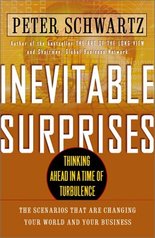
Schwartz bir süredir içinde bulunduğumuz ve bir süre daha içinde olacağımız çalkantılı zamanlar (turbulent environment) için şu üç temel değişmezin altını çiziyor:
- Önümüzde yeni sürprizler olacak.
- Bu sürprizlerle başa çıkabileceğiz.
- Bu sürprizlerin çoğunu kestirebileceğiz. Hatta pek çoğunun ne kadar etkili olacağı yönünde oldukça sağlam tahminlerde de bulunabileceğiz.
Bu noktadan hareketle de önümüzdeki 25 yıl içerisinde bizi bekleyen “kaçınılmaz sürprizler”i sıralıyor:
- Yaşlılarıyla Bütünleşmiş bir Dünya: Dünya gittikçe daha yaşlı bir yer olacak. Temelde tıpdaki gelişmeler nedeniyle dalya diyenler gittikçe çoğalacak, emeklilik yaşı 90’lara dayanacak. Bu yaşlanmanın çok ciddi sosyal ve ekonomik yansımaları olacak.
- Büyük İnsan Seli: Pek çeşitli nedenlerle bölgesel ve küresel göç hareketleri artacak. Çin’in yerli tüketim fazlası delikanlıları, Amerika’ya durmak bilemeyen Latin ve Asyalı akımı, Avrupa’nın Kuzey Afrika, Orta ve Yakın Doğu göçmenleri. Her toplumun bu yeni ve farklı gruplarla ilişkisi geleceğinde önemli rol oynayacak.
- Uzun Patlama’nın Geri Dönüşü: Münferit inkıtalara (.com köpüğünün patlaması gibi) karşın uzun patlama (long boom) on yıllarca devam edecek. Verimlilik artışı, küreselleşme, iyileşen altyapı vb. etkenler uzun patlamanın kaçınılmazlığını sağlayacaklar.
- Tümüyle Yeni Dünya Düzeni: Bir tarafta düzenli ülkeler yer alacak: Amerika’nın kolpa süper gücü (rogue superpower) ile AB’nin yumuşak gücü (soft power).
- Düzensizlik Kataloğu: Diğer tarafta da düzensizlik, kaos ve terörizmin beşiği haline gelebilecek tehlike bölgeleri: Radikal İslam’ın kaderini belirleyecek Suudi Arabistan, Mısır ve Pakistan, gelecek din savaşlarına sahne olacak Filipinler, Endonezya, Nijerya ve Kongo, Kolombiyalaşma ve uyuşturucu savaşları tehditindeki Meksika, düzen ile suç devleti arasında bocalayan Hazar Havzası, 19. yüzyıla dönme endişesi yaşayan Sahra-altı Afrika ve düzenin önündeki son engel Afrika, Çin, Rusya ve Hindistan’daki AIDS.
- Atılımda Atılım: Bilim ve Teknoloji: Schwartz üç çeşit atılım bekliyor: Halen yürütülmekte olan çalışmaların yaratacağı atılımlar (nanoteknoloji, sensörler, bilgi işleme, …), bugünkü bilimin sınırlarında yer alan atılımlar (biyoteknoloji, genetik mühendislik, kuantum bilgisayarlar, …) ve paradigma değiştiren atılımlar (gerçekliğin çözülmesi, kara madde, kuantum “ışınlama”, …).
- Daha Temiz ve Ölümcül Bir Dünya: Rahatlayın, dünya nüfusunun artışı sorun yaratmayacak. Çevreyi de yok etmeyeceğiz. Hatta gittikçe daha temiz bir dünyada yaşayacağız, zaten son birkaç on yıldır da yaşıyoruz. Ama küresel iklim değişikliği kaçınılmaz bir tehdit olarak karşımızda duruyor. Ya da bir göktaşı çarpması, ya da yeni bir salgın hastalık.
Genelde oldukça eğlenceli ve akıcı bir okuma. The Long Boom‘a göre çok daha gerçekçi bir eser, ki yazılma zamanları düşünüldüğünde öyle olması da doğal. Ama Schwartz yine de iyimser bir gözle bakıyor çevresine.
Gelecekçilere, Schwartz takipçilerine ve bilim-kurgu /ütopya /distopya meraklılarına (dikkat, kitap bir kurgu değil; ama Schwartz ve arkadaşları The Minority Report‘taki geleceği çizen ekip) öneririm.
-
Frederick P. Brooks: “The Mythical Man-Month”
Uludağ projesinin planlamasını yaparken ben “adam-ay” lafını ettikçe Serdar Hoca köpürdü durdu. Ertesi gün de The Mythical Man-Month üzerine kurulu ve meşhur bir üniversitede okutulan bir dersin sunum dosyalarını gönderdi. “Ne demek istiyorsun hocam?” deyince birşey söylemedi. Bana da kitabı alıp okumak düştü.

Kitap zaten yazılım geliştirme projeleri konusunda kalem oynatanların bahsetmeden geçemeyecekleri yücelik ve kutsallıkta bir metin. Zaten yakın zamanda okuduğum ve okumakta olduğum O’Connel ile McConnell da saygı ile anıyorlar. Ama ben bir proje yöneticisinden çok bir yazılım geliştiricisi, özellikle mimarının okuması gerektiğini düşünüyorum.
Kitabı özetlemek yerine Brooks’un kendi kaleminden MMM’nin Önermeleri kısmını olduğu gibi aktarıyorum aşağıda. Biraz uzun olacak, ama bence okumaya değer. Ben özellikle 1.2, 1.3 ve 5.2 maddelerine dikkat çekmek istiyorum.
Şimdilik yalnızca tarihi kitabı okudum. Tümünü bitirmeden eldekileri paylaşmak istedim. No Silver Bullet ve devamını bitirince bir yorum eklerim herhalde.
Kitabın tarihi niteliği de önemli. “… it need to be fast, but it needs at least a million bytes of main storage, a hundred million bytes of on-line disk, and terminals.” cümlesinin geçtiği bir kitaba bu devirde raslamak o kadar kolay değil. Ama yanlış anlamayın, içindeki fikirler kesinlikle eski ve naftalinli değil, son derece güncel.
Yazılım sistemleri geliştirecek, özellikle ekip halinde çalışacak programcılar için okunması şart bir kitap bence. Ben Uludağ geliştiricilerinin kitabın tümünü ilk fırsatta okumalarını isteyeceğim.
- Propositions of the Mythical Man-Month
1. The Tar Pit.
1.1. A programming systems product takes about nine times as much effort as the component programs written separately for private use. I estimate that productizing imposes a factor of three; and that designing, integrating, and testing components into a coherent system imposes a factor of three; and that these cost components are essentially independent of each other.
1.2. The craft of programming gratifies creative longings built deep within us and delights sensibilities we have in common with all men, providing five kinds of joys:- The joy of making things
- The joy of making things that are useful to other people
- The fascination of fashioning puzzle-like objects of interlocking moving parts
- The joy of always learning, of a nonrepeating task
- The delight of working in a medium so tractable – pure thought-stuff – which nevertheless exists, moves, and works in a way that word-objects do not.
1.3. Likewise the craft has special woes inherent in it.
- Adjusting to the requirement of perfection is the hardest part of learning to program.
- Others set one’s objectives and one must depend upon things (especially programs) one cannot control; the authority is not equal to the responsibility.
- This sounds worse than it is: actual authority comes from momentum of accomplishment.
- With any creativity come dreary hours of painstaking labor programming is no exception.
- The programming project converges more slowly the nearer one gets to the end, whereas one expects it to converge faster as one approaches the end.
- One’s product is always threatened with obsolescence before completion. The real tiger is never a match for the paper one, unless real use is wanted.
2. The Mythical Man-Month.
2.1. More programming projects have gone awry for lack of calendar time than for all other causes combined.
2.2. Good cooking takes time; some tasks cannot be hurried without spoiling the result.
2.3. All programmers are optimists: “All will go well.”
2.4. Because the programmer builds with pure thought-stuff, we expect few difficulties in implementation.
2.5. But our ideas themselves are faulty, so we have bugs.
2.6. Our estimating techniques, built around cost-accounting, confuse effort and progress. The man-month is a fallacious and dangerous myth, for it implies that men and months are interchangeable.
2.7. Partitioning a task among multiple people occasions extra communication effort – training and intercommunication.
2.8. My rule of thumb is 1/3 of the schedule for design, 1/6 for coding, 1/4 for component testing, and 1/4 for system testing.
2.9. As a discipline, we lack estimating data.
2.10. Because we are uncertain about our scheduling estimates, we often lack the courage to defend them stubbornly against management and customer pressure.
2.11. Brooks’s Law: Adding manpower to a late software project makes it late
2.12. Adding people to a software project increases the total effort necessary in three ways: the work and disruption of repartitioning itself, training the new people, and added intercommunication.3. The Surgical Team.
3.1. Very good professional programmers are ten times as productive as poor ones, at same training and two-year experience level. (Sackman, Grant, and Erickson)
3.2. Sackman, Grant, and Erickson’s data showed no correlation whatsoever between experience and performance. I doubt the universality of that result.
3.3. A small sharp team is best – as few minds as possible.
3.4. A team of two, with one leader, is often the best use of minds. (Note God’s plan for marriage.)
3.5. A small sharp team is too slow for really big systems.
3.6. Most experiences with really large systems show the brute-force approach to scaling up to be costly, slow, inefficient, and to produce systems that are not conceptually integrated.
3.7. A chief-programmer, surgical-team organization offers a way to get the product integrity of few minds and the total productivity of many helpers, with radically reduced communication.4. Aristocracy, Democracy, and System Design.
4.1. Conceptual integrity is the most important consideration in system design.
4.2. The ratio of function to conceptual complexity is the ultimate test of system design, not just the richness of function. (This ratio is a measure of ease of use, valid over both simple and difficult uses.)
4.3. To achieve conceptual integrity, a design must proceed from one mind or a small group of agreeing minds.
4.4. Separation of architectural effort from implementation is a very powerful way of getting conceptual integration on very large projects. (Small ones, too.)
4.5. If a system is to have conceptual integrity, someone must control the concepts. That is an aristocracy that needs no apology.
4.6. Discipline is good for art. The external provision of an architecture enhances, not cramps, the creative style of an implementing group.
4.7. A conceptually integrated system is faster to build and to test.
4.8. Much of software architecture, implementation, and realization can proceed in parallel. (Hardware and software design can likewise proceed in parallel.)5. The Second-System Effect.
5.1. Early and continuous communication can give the architect good cost readings and the builder confidence in the design, without blurring the clear division of responsibilities.
5.2. How an architect can successfully influence implementation:- Remember that the builder has the creative responsibility for implementation; the architect only suggests.
- Always be ready to suggest a way of implementing anything one specifies; be prepared to accept any other equally good way.
- Deal quietly and privately in such suggestions.
- Be ready to forgo credit for suggested improvements.
- Listen to the builder’s suggestions for architecture improvements.
5.3. The second is the most dangerous system a person ever designs; the general tendency is to overdesign it.
5.4. OS/360 is a good example of the second system effect. (Windows NT seems to be a 1990s example.)
5.5. Assigning a priori values in bytes and microseconds to functions is a worthwhile discipline.6. Passing the Word.
6.1. Even when a design team is large, the results must be reduced to writing by one or two, in order that the mini decisions be consistent.
6.2. It is important to explicitly define the parts of an architecture that are not prescribed as carefully as those that are.
6.3. One needs both a formal definition of a design, for precision, and a prose definition for comprehensibility.
6.4. One of the formal and prose definitions must be standard, and the other derivative. Either definition can serve in either role.
6.5. An implementation, including a simulation, can serve as an architectural definition; such use has formidable disadvantages.
6.6. Direct incorporation is a very clean technique for enforcing an architectural standard in software. (In hardware, too – consider the Mac WIMP interface built into ROM.)
6.7. An architectural definition will be cleaner and the (architectural) discipline tighter if at least two implementations are built initially.
6.8. It is important to allow telephone interpretations by an architect in response to implementers’ queries; it is imperative to log these and publish them. (Electronic mail is now the medium of choice.)
6.9. “The project manager’s best friend is his daily adversary, the independent producttesting organization.”7. Why Did the Tower of Babel Fail?
7.1. The Tower of Babel project failed because of lack of communication and of its consequent, organization.
7.2. Schedule disaster, functional misfit, and system bugs all arise because the left hand doesn’t know what the right hand is doing. Teams drift apart in assumptions.
7.3. Teams should communicate with one another in as many ways as possible: informally, by regular project meetings with technical briefings, and via a shared formal project workbook. (And by electronic mail.)
7.4. A project workbook is not so much a separate document as it is a structure imposed on the documents that the project will be producing anyway.
7.5. All the documents of the project need to be part of this (workbook) structure.
7.6. The workbook structure needs to be designed carefully and early.
7.7. Properly structuring the ongoing documentation from the beginning molds later writing into segments that fit into that structure and will improve the product manuals.
7.8. Each team member should see all the (workbook) material. (I would now say, each team member should be able to see all of it. That is, World Wide Web pages would suffice.)
7.9. Timely updating is of critical importance.
7.10. The user needs to have attention especially drawn to changes since his last reading, with remarks on their significance.
7.11. The OS/360 Project workbook started with paper and switched to microfiche.
7.12. Today (even in 1975), the shared electronic notebook is much better, cheaper, and simpler mechanism for achieving all these goals.
7.13. One still has to mark the text with (the functional equivalent of) change bars and revision dates. One still needs a LIFO electronic change summary.
7.14. Parnas argues strongly that the goal of everyone seeing everything is totally wrong; parts should be encapsulated so that no one needs to or is allowed to see the internals of any parts other than his own, but should see only the interfaces.
7.15. Parnas’s proposal is a recipe for disaster. (I have been quite convinced otherwise by Parnas, and totally changed my mind.)
7.16. The purpose of organization is to reduce the amount of communication and coordination necessary.
7.17. Organization embodies division of labor and specialization of function in order to obviate communication.
7.18. The conventional tree organization reflects the authority structure principle that no person can serve two masters.
7.19. The communication structure in an organization is a network, not a tree, so all kinds of special organization mechanisms (-dotted lines-) have to be devised to overcome the communication deficiencies of the treestructured organization.
7.20. Every subproject has two leadership roles to be filled, that of the producer and that of the technical director, or architect. The functions of the two roles are quite distinct and require different talents.
7.21. Any of three relationships among the two roles can be quite effective:- The producer and director can be the same.
- The producer may be boss, and the director the producer’s righthand person.
- The director may be boss, and the producer the director’s righthand person.
8. Calling the Shot.
8.1. One cannot accurately estimate the total effort or schedule of a programming project by simply estimating the coding time and multiplying by factors for the other parts of the task.
8.2. Data for building isolated small systems are not applicable to programming systems projects.
8.3. Programming increases goes as a power of program size.
8.4. Some published studies show the exponent to be about 1.5. (Boehm’s data do not at all agree with this, but vary from 1.05 to 1.2.)
8.5. Portman’s ICL data show fulltime programmers applying only about 50 percent of their time to programming and debugging, versus other overheadtype tasks.
8.6. Aron’s IBM data show productivity varying from 1.5 K lines of code (KLOC) per manyear to 10 KLOC/manyear as a function of the number of interactions among system parts.
8.7. Harr’s Bell Labs data show productivities on operatingsystemstype work to run about 0.6 KLOC/manyear and on compilertype work about 2.2 KLOC/manyear for finished products.
8.8. Brooks’s OS/360 data agrees with Harr’s: 0.6-0.8 KLOC/ manyear on operating systems and 2-3 KLOC/manyear on compilers.
8.9. Corbató’s MIT Project MULTICS data show productivity of 1.2 KLOC/manyear on a mix of operating systems and compilers, but these are PL/I lines of code, whereas all the other data are assembler lines of code!
8.10. Productivity seems constant in terms of elementary statements.
8.11. Programming productivity may be increased as much as five times when a suitable high level language is used.9. Ten Pounds in a Five-Pound Sack.
9.1. Aside from running time, the memory space occupied by a program is a principal cost. This is especially true for operating systems, where much is resident all the time.
9.2. Even so, money spent on memory for program residence may yield very good functional value per dollar, better than other ways of investing in configuration. Program size is not bad; unnecessary size is.
9.3. The software builder must set size targets, control size, and devise sizereduction techniques, just as the hardware builder does for components.
9.4. Size budgets must be explicit not only about resident size but also about the disk accesses occasioned by program fetches.
9.5. Size budgets have to be tied to function assignments; define exactly what a module must do when you specify how big it must be.
9.6. On large teams, subteams tend to suboptimize to meet their own targets rather than think about the total effect on the user. This breakdown in orientation is a major hazard of large projects.
9.7. All during implementation, the system architects must maintain constant vigilance to ensure continued system integrity.
9.8. Fostering a totalsystem, useroriented attitude may well be the most important function of the programming manager.
9.9. An early policy decision is to decide how finegrained the user choice of options will be, since packaging them in clumps saves memory space (and often marketing costs).
9.10. The size of the transient area, hence of the amount of program per disk fetch, is a crucial decision, since performance is a superlinear function of that size. (This whole decision has been obsoleted, first by virtual memory, then by cheap real memory. Users now typically buy enough real memory to hold all the code of major applications.)
9.11. To make good spacetime tradeoffs, a team needs to be trained in the programming techniques peculiar to a particular language or machine, especially a new one.
9.12. Programming has a technology, and every project needs a library of standard components.
9.13. Program libraries should have two versions of each component, the quick and the squeezed. (This seems obsolete today.)
9.14. Lean, spare, fast programs are almost always the result of strategic breakthrough, rather than tactical cleverness.
9.15. Often such a breakthrough will be a new algorithm.
9.16. More often, the breakthrough will come from redoing the representation of the data or tables. Representation is the essence of programming.10. The Documentary Hypothesis.
10.1. “The hypothesis: Amid a wash of paper, a small number of documents become the critical pivots around which every project’s management revolves. These are the manager’s chief personal tools.”
10.2. For a computer development project, the critical documents are the objectives, manual, schedule, budget, organization chart, floorspace allocation, and the estimate, forecast, and prices of the machine itself.
10.3. For a university department, the critical documents are similar: the objectives, degree requirements, course descriptions, research proposals, class schedule and teaching plan, budget, floorspace allocation, and assignments of staff and graduate assistants.
10.4. For a software project, the needs are the same: the objectives, user manual, internals documentation, schedule, budget, organization chart, and floorspace allocation.
10.5. Even on a small project, therefore, the manager should from the beginning formalize such a set of documents.
10.6. Preparing each document of this small set focuses thought and crystallizes discussion. The act of writing requires hundreds of minidecisions, and it is the existence of these that distinguish clear, exact policies from fuzzy ones.
10.7. Maintaining each critical document provides a status surveillance and warning mechanism.
10.8. Each document itself serves as a checklist and a database.
10.9. The project manager’s fundamental job is to keep every body going in the same direction.
10.10. The project manager’s chief daily task is communication, not decisionmaking; the documents communicate the plans and decisions to the whole team.
10.11. Only a small part of a technical project manager’s timeperhaps 20 percent is spent on tasks where he needs information from outside his head.
10.12. For this reason, the touted market concept of a “management total-information system” to support executives is not based on a valid model of executive behavior.11. Plan to Throw One Away.
11.1. Chemical engineers have learned not to take a process from the lab bench to the factory in one step, but to build a pilot plant to give experience in scaling quantities up and operating in nonprotective environments.
11.2. This intermediate step is equally necessary for programming products, but software engineers do not yet routinely fieldtest a pilot system before undertaking to deliver the real product. (This has now become common practice, with a beta version. This is not the same as a prototype with limited function, an alpha version, which I would also advocate.)
11.3. For most projects, the first system built is barely usable, too slow, too big, too hard to use, or all three.
11.4. The discard and redesign may be done in one lump, or piecebypiece, but it will be done.
11.5. Delivering the first system, the throwaway, to users will buy time, but only at the cost of agony for the user, distraction for the builders supporting it while they do the redesign, and a bad reputation for the product that will be hard to live down.
11.6. Hence, plan to throw one away; you will, anyhow.
11.7. “The programmer delivers satisfaction of a user need rather than any tangible product.” (Cosgrove)
11.8. Both the actual need and the user’s perception of that need will change as programs are built, tested, and used.
11.9. The tractability and the invisibility of the software product expose its builders (exceptionally) to perpetual changes in requirements.
11.10. Some valid changes in objectives (and in development strategies) are inevitable, and it is better to be prepared for them than to assume that they will not come.
11.11. The techniques for planning a software product for change, especially structured programming with careful module interface documentation, are well known but not uniformly practiced. It also helps to use tabledriven techniques wherever possible. (Modern memory costs and sizes make such techniques better and better.)
11.12. Use high level language, compiletime operations, incorporations of declarations by reference, and selfdocumenting techniques to reduce errors induced by change.
11.13. Quantify changes into well defined numbered versions. (Now standard practice.)
11.14. Programmer reluctance to document designs comes not so much from laziness as from the hesitancy to undertake defense of decisions that the designer knows are tentative. (Cosgrove)
11.15. Structuring an organization for change is much harder than designing a system for change.
11.16. The project boss must work at keeping the managers and the technical people as interchangeable as their talents allow; in particular, one wants to be able to move people easily between technical and managerial roles.
11.17. The barriers to effective dual-ladder organization are sociological, and they must be fought with constant vigilance and energy.
11.18. It is easy to establish corresponding salary scales for the corresponding rungs on a dual ladder, but it requires strong proactive measures to give them corresponding prestige: equal offices, equal support services, overcompensating management actions.
11.19. Organizing as a surgical team is a radical attack on all aspects of this problem. It is really the longrun answer to the problem of flexible organization.
11.20. Program maintenance is fundamentally different from hardware maintenance; it consists chiefly of changes that repair design defects, add incremental function, or adapt to changes in the use environment or configuration.
11.21. The total lifetime cost of maintaining a widely used program is typically 40 percent or more of the cost of developing it.
11.22. Maintenance cost is strongly affected by the number of users. More users find more bugs.
11.23. Campbell points out an interesting dropandclimb curve in bugs per month over a product’s life.
11.24. Fixing a defect has a substantial (20 to 50 percent) chance of introducing another.
11.25. After each fix, one must run the entire bank of test cases previously run against a system to ensure that it has not been damaged in an obscure way.
11.26. Methods of designing programs so as to eliminate or at least illuminate side effects can have an immense payoff in maintenance costs.
11.27. So can methods of implementing designs with fewer people, fewer interfaces, and fewer bugs.
11.28. Lehman and Belady find that the total number of modules increases linearly with the release number of a large operating system (OS/360), but that the number of modules affected increases exponentially with the release number.
11.29. All repairs tend to destroy structure, to increase the entropy and disorder of a system. Even the most skillful program maintenance only delays the program’s subsidence into unfixable chaos, from which there has to be a groundup redesign. (Many of the real needs for upgrading a program, such as performance, especially attack its internal structural boundaries. Often the original boundaries occasioned the deficiencies that surface later.)12. Sharp Tools.
12.1. The manager of a project needs to establish a philosophy and set aside resources for the building of common tools, and at the same time to recognize the need for personalized tools.
12.2. Teams building operating systems need a target machine of their own on which to debug; it needs maximum memory rather than maximum speed, and a system programmer to keep the standard software current and serviceable.
12.3. The debugging machine, or its software, also needs to be instrumented, so that counts and measurements of all kinds of program parameters can be automatically made.
12.4. The requirement for target machine use has a peculiar growth curve: low activity followed by explosive growth, then leveling off.
12.5. System debugging, like astronomy, has always been done chiefly at night.
12.6. Allocating substantial blocks of target machine time to one subteam at a time proved the best way to schedule, much better than interleaving subteam use, despite theory.
12.7. This preferred method of scheduling scarce computers by blocks has survived 20 years (in 1975) of technology change because it is most productive. (It still is, in 1995).
12.8. If a target computer is new, one needs a logical simulator for it. One gets it sooner, and it provides a dependable debugging vehicle even after one has a real machine.
12.9. A master program library should be divided into (1) a set of individual playpens, (2) a system integration sublibrary, currently under system test, and (3) a released version. Formal separation and progression gives control.
12.10. The tool that saves the most labor in a programming project is probably a text editing system.
12.11. Voluminosity in system documentation does indeed introduce a new kind of incomprehensibility (see Unix, for example), but it is far preferable to the severe under-documentation that is so common.
12.12. Build a performance simulator, outside in, top down. Start it very early. Listen when it speaks.
12.13. Only sloth and inertia prevent the universal adoption of high level language and interactive programming. (And today they have been adopted universally.)
12.14. high level language improves not only productivity but also debugging; fewer bugs and easier to find.
12.15. The classical objections of function, object code space, and object code speed have been made obsolete by the advance of language and compiler technology.
12.16. The only reasonable candidate for system programming today is PL/I. (No longer true.)
12.17. Interactive systems will never displace batch systems for some applications. (Still true.)
12.18. Debugging is the hard and slow part of system programming, and slow turnaround is the bane of debugging.
12.19. Limited evidence shows that interactive programming at least doubles productivity in system programming.13. The Whole and the Parts.
13.1. The detailed, painstaking architectural effort implied in Chapters 4, 5, and 6 not only makes a product easier to use, it makes it easier to build and reduces the number of system bugs that have to be found.
13.2. Vyssotsky says “Many, many failures concern exactly those aspects that were never quite specified.”
13.3. Long before any code itself, the specification must be handed to an outside testing group to be scrutinized for completeness and clarity. The developers themselves cannot do this. (Vyssotsky)
13.4. “Wirth’s top-down design (by stepwise refinement) is the most important new programming formalization of the (1965-1975) decade.”
13.5. Wirth advocates using as high level a notation as possible on each step.
13.6. A good topdown design avoids bugs in four ways.
13.7. Sometimes one has to go back, scrap a high level, and start over.
13.8. Structured programming, designing programs whose control structuresconsist only of a specified set that govern blocks of code (versus miscellaneous branching), is a sound way to avoid bugs and is the right way to think.
13.9. Gold’s experimental results show three times as much progress is made in the first interaction of an interactive debugging session as on subsequent interactions. It still pays to plan debugging carefully before signing on. (I think it still does, in 1995.)
13.10. I find that proper use of a good (quick response interactive debugging) system requires two hours at the desk for each two hour session on the machine: one hour in sweeping up and documenting after the session and one in planning changes and tests for the next time.
13.11. System debugging (in contrast to component debugging) will take longer than one expects.
13.12. The difficulty of system debugging justifies a thoroughly systematic and planned approach.
13.13. One should begin system debugging only after the pieces seem to work (versus bolt-it-together-and-try in order to smoke out the interface bugs; and versus starting system debugging when the component bugs are fully known but not fixed.) (This is especially true for teams.)
13.14. It is worthwhile to build lots of debugging scaffolding and test code, perhaps even 50 percent as much as the product being debugged.
13.15. One must control and document changes and versions, with team members working in playpen copies.
13.16. Add one component at a time during system debugging.
13.17. Lehman and Belady offer evidence the change quanta should be large and infrequent or else very small and frequent. The latter is more subject to instability. (A Microsoft team makes small frequent quanta work. The growing system is rebuilt every night.)14. Hatching a Castrophe.
14.1. “How does a project get to be a year late? One day at a time.”
14.2. Day by day schedule slippage is harder to recognize, harder to prevent, and harder to make up than calamities.
14.3. The first step in controlling a big project on a tight schedule is to have a schedule, made up of milestones and dates for them.
14.4. Milestones must be concrete, specific, measurable events defined with knifeedge sharpness.
14.5. A programmer will rarely lie about milestone progress, if the milestone is so sharp he can’t deceive himself.
14.6. Studies of estimating behavior by government contractors on large projects show that activity time estimates revised carefully every two weeks do not significantly change as the start time approaches, that during the activity overestimates come steadily down; and that underestimates do not change until about three weeks before scheduled completion.
14.7. Chronic schedule slippage is a morale killer. (Jim McCarthy of Microsoft says, “If you miss one deadline, make sure you make the next one.”)
14.8. Hustle is essential for great programming teams, just as for great baseball teams.
14.9. There is no substitute for a critical path schedule to enable one to tell which slips matter how much.
14.10. The preparation of a critical path chart is the most valuable part of its use, since laying out the network, identifying the dependencies, and estimating the segments force a great deal of very specific planning very early in a project.
14.11. The first chart is always terrible, and one invents and invents in making the next one.
14.12. A critical path chart answers the demoralizing excuse, “The other piece is late, anyhow.”
14.13. Every boss needs both exception information that requires action and a status picture for education and distant early warning.
14.14. Getting the status is hard, since subordinate managers have every reason not to share it.
14.15. By bad action, a boss can guarantee to squelch full status disclosure; conversely, carefully separating status reports and accepting them without panic or preemption will encourage honest reporting.
14.16. One must have review techniques by which true status becomes known to all players. For this purpose a milestone schedule and completion document is the key.
14.17. Vyssotsky: “I have found it handy to carry both “scheduled” (boss’s dates) and “estimated” (lowestlevel manager’s dates) dates in the milestone report. The project manager has to keep his fingers off the estimated dates.”
14.18. A small Plans and Controls team that maintains the milestone report is invaluable for a large project.15. The Other Face.
15.1. For the program product, the other face to the user, the documentation, is fully as important as the face to the machine.
15.2. Even for the most private of programs, prose documentation is necessary, for memory will fail the user-author.
15.3. Teachers and managers have by and large failed to instill in programmers an attitude about documentation that will inspire for a lifetime, overcoming sloth and schedule pressure.
15.4. This failure is not due so much to lack of zeal or eloquence as to a failure to show how to document effectively and economically.
15.5. Most documentation fails in giving too little overview. Stand way back and zoom in slowly.
15.6. The critical user documentation should be drafted before the program is built, for it embodies basic planning decisions. It should describe nine things (see the chapter).
15.7. A program should be shipped with a few test cases, some for valid input data, some for borderline input data, and some for clearly invalid input data.
15.8. Documentation of program internals, for the person who must modify it, also demands a prose overview, which should contain five kinds of things (see the chapter).
15.9. The flow chart is a most thoroughly oversold piece of program documentation; the detailed blowbyblow flow chart is a nuisance, obsoleted by written high level languages. (A flow chart is a diagrammed high level language.)
15.10. Few programs need more than a onepage flow chart, if that. (MILSPEC documentation requirements are really wrong on this point.)
15.11. One does indeed need a program structure graph, which does not need the ANSI flowcharting standards.
15.12. To keep documentation maintained, it is crucial that it be incorporated in the source program, rather than kept as a separate document.
15.13. Three notions are key to minimizing the documentation burden:- Use parts of the program that have to be there anyway, such as names and declarations, to carry as much of the documentation as possible.
- Use space and format to show subordination and nesting and to improve readability.
- Insert the necessary prose documentation into the program as paragraphs of comment, especially as module headers.
15.14. In documentation for use by program modifiers, tell why things are like they are, rather than merely how they are. Purpose is the key to understanding even high level language syntax does not at all convey purpose.
15.15. Self-documenting programming techniques find their greatest use and power in high level languages used with online systems, which are the tools one should be using.Epilogue.
E.1. Software systems are perhaps the most intricate and complex (in terms of number of distinct kinds of parts) of the things humanity makes.
E.2. The tar pit of software engineering will continue to be sticky for a long time to come. -
Uludağ Barometresi
Başarı İhtimali Endeksi: 35
Hayatta Kalma Endeksi: 56
Hedef 10 Yapılacak İşler 4 Lider 10 İş Bölümü 1 Beklentiler / Riskler 2 Liderlik 1 Takip 1 İlan 2 Tekrar – Ödül – Başarı İhtimali Endeksi
35
Bir önceki değer: 12 @ 13 Eylül
Gerekler Projenin kısa ve açık bir vizyon cümlesi var mı? 3 Tüm ekip elemanları vizyonun gerçekçi olduğuna inanıyorlar mı? 2 Projenin iş yararlarını ve bu yararların nasıl ölçüleceğini açıklayan bir iş durumu var mı? 0 Projenin gerçek sistemi düzgün ve canlı bir şekilde gösteren bir kullanıcı arayüz prototipi var mı? 0 Projenin yazılımın yeteneklerine ilişkin ayrıntılı ve yazılı bir özellikler dokümanı var mı? 0 Proje ekibi yazılımı kullanacak son kullanıcılarla ilk safhalarda görüştü mü ve son kullanıcıları projeye dahil ediyorlar mı? 0 Projenin ayrıntılı ve yazılı bir Yazılım Geliştirme Planı var mı? 0 Projenin iş listesi bir kurulum programı yazılmasını, veri çevrimini, üçüncü parti yazılımlarla entegrasyonu, müşteri toplantılarını ve diğer “ufak” işleri içeriyor mu? 1 Zaman ve bütçe tahminleri en son bitirilen faz sonrasında gözden geçirildi mi? 1 Projenin ayrıntılı ve yazılı mimari ve tasarım dokümanları var mı? 0 Projenin sistem testleri yanında tasarım ve kod gözden geçirmelerini de içeren ayrıntılı ve yazılı bir Kalite Güvence Planı var mı? 0 Projenin yazılımın gerçekleştirileceği ve sunulacağı aşamaları açıklayan ayrıntılı bir Aşamalı Sunuş Planı var mı? 0 Proje planı tatiller, izinler, hastalık, eğitim, vb. için zaman ayırmış mı; kaynaklar %100’den daha az kullanılmış mı? 1 Proje planı ve takvimi geliştirme ekibi, kalite güvence ekibi ve teknik yazım ekibi tarafından onaylandı mı? 0 Proje Kontrolü Proje karar verme yetkisine sahip tek bir yönetici sorumluluğunda mı; bu yönetici projeyi sahipleniyor mu? 3 Proje yöneticisinin iş yükü projeye yeterli zaman ayırmasına uygun mu? 2 Proje iyi tanımlanmış ayrıntılı kilometre taşlarına (%100 yapılmış ya da %100 yapılmamış sayılabilecek “ikil kilometre taşları”) sahip mi? 1 Bir proje paydaşı bu kilometre taşlarının hangisine ulaşılıp, hangisine ulaşılmadığını kolayca öğrenebiliyor mu? 0 Proje ekibinin sorunları isimsiz olarak yöneticilerine ya da üst yönetime iletebilecekleri iletişim kanalları oluşturuldu mu? 0 Projenin yazılım gereklerindeki değişiklikleri kontrol için yazılı bir planı var mı? 2 Projenin önerilen değişiklikleri kabul ya da red etme nihai yetkisine sahip bir Değişiklik Kontrol Kurulu var mı? 3 Planlama malzemeleri ve durum bilgisi —iş gücü ve zaman tahminleri, iş atamaları, ve ilerlemenin planla karşılaştırılması da dahil olacak şekilde— tüm ekip elemalarına açık mı? 2 Tüm kaynak kodu otomatik değişiklik kontrol sistemine konmuş mu? 2 Proje ortamı gerekli temel araçları —hata izleme sistemi, kaynak kodu kontrolü, proje yönetim yazılımı gibi— barındırıyor mu? 2 Risk Yönetimi Proje planı mevcut riskleri içeriyor mu? Risk listesi yakın zamanda güncellendi mi? 3 Proje oluşacak riskleri belirlemekle görevli bir risk memuruna sahip mi? 3 Personel Proje ekibi projeyi tamamlamak için gerekli tüm teknik bilgi birikimine ve deneyime sahip mi? 2 Proje ekibi yazılımın kullanılacağı ortam ile ilgili bilgi birikimi ve deneyime sahip mi? 2 Projenin yetkin bir teknik lideri var mı? 2 Yapılacak işlere yetecek sayıda eleman mevcut mu? 1 Ekip iyi anlaşıyor mu? 2 Tüm elemanlar projeye gönül vermişler mi? 2 Toplam Ham sonuç 42 Projenin alt yüklenicisi yok +3 Proje ekibi 5 kişi x1.25 Hayatta Kalma Endeksi
56,25
Bir önceki değer: 21 @ 13 Eylül
-
Fergus O’Connell: “How to Run Successful Projects III: The Silver Bullet”
Dün, daha çok Zülal Hanım’ı görmek ve biraz laflamak için, kütüphaneye uğradım. Gerek kütüphaneden alınma, gerekse kendi aldığım ne kadar çok kitabın okunmayı beklediğinden; uzun süre kütüphaneden kitap almayacağımdan, . bahsederken gözüme çarptı. Adını daha önce duymuştum, aldım, evirdim, çevirdim. Tüm tevbelerime rağmen aldım, yolda, şurda-burda okudum ve neredeyse bir solukta bitirdim. Her proje yöneticisine tavsiye edilebilecek bir kitap işte: How to Run Successful Projects III: The Silver Bullet
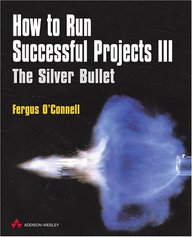
Kitabın temel mesajı şöyle:
İyi planlanmış bir projenin başarısız, kötü planlanmış bir projenin başarılı olma olasılığı yoktur!
Evet, biraz sert bir mesaj, ama sayfa sayfa, bölüm bölüm sürekli tekrarlanan aynı şey: “Projenizi iyi planlayın!”.
Yapısal proje yönetimi için on adım sıralanmış:
- Hedefi gözünüzde şekillendirin, (20)
- Yapılacak işleri listeleyin, (20)
- Tek lider siz olun, (10)
- İşleri kişilere atayın, (10)
- Beklentileri yönetin, hata için bir marj bırakın, bir garanti çıkışınız olsun, (10)
- Uygun bir liderlik stili benimseyin, (10)
- Olan biteni fark edin, (10)
- İnsanları olan bitenden haberdar edin, (10)
- 1-8. adımları tekrar edin, ta ki 10. adıma kadar (0)
- Ödül! (0)
Dikkat ederseniz 10 adımdan 5’i projenin planlanma aşamasında yer alıyorlar, yalnızca son 5’i (ki bunlardan iki tanesi de aşikar) projenin nasıl yürütüldüğünü irdeliyor. Listede parantez içindeki sayılar o adımın Başarı İhtimali Endeksi’ndeki (BİE) ağırlığı. Aynı şekilde proje planının BİE’deki ağırlığı 70, projenin yürütülmesi ise yalnızca 30 puan katkıda bulunuyor. O’Connell’a göre planlama aşamasında 40 puan toplanınca proje başarılı olma yoluna giriyor. Toplamda da 60 puanı geçmek gerekiyor.
O’Connell sağlam bir waterfall uygulayıcısı gibi duruyor. Eminim pek çok acil (agile) programlamacının bu kitabı okurken tüyleri diken diken olacaktır, şayet okurlarsa 😉
Özellikle birden çok projeye bulaşmış proje yöneticilerinin Tembel Proje Yöneticisi profiline imreneceklerini tahmin ediyorum. Aslında “Akıllı” demek daha yerinde olacaktır, bu akıllılıktan dolayı tembellik yapmaya hak kazanıyor.
Kitabın sonunda problem çözme, karar verme, stresle başa çıkma, doğru elemanları seçme, pazarlık, toplantılar, sunumlar gibi yumuşak konular üzerine de kısa kısa eğilmiş O’Connell. Hatta Microsoft Project 2000 öğretmeye ayrılmış bir de ek bölümü var kitabın.
Genelde reçeteli kitaplardan hoşlanmam. Ama The Silver Bullet gerçekten kurtadamlarla başa çıkmanın yollarını anlatıyor gibime geldi. Belki benim tarzıma fena halde koşut gittiği için. Proje yöneticisinin başucu ve hatta el kitabı olabilecek nitelikte. Tavsiye ediyorum.
-
En İyi 10 Bilim-Kurgu Filmi
İngiliz The Guardian gazetesi büyükçe bir grup (çoğunluğu Birleşik Krallık’ta yerleşik) bilimciye en iyi bilim-kurgu filmleri ve kitaplarını sormuşlar ve yanıtları bir “En İyi 10” listesinde toplamışlar. İşte sonuçlar:
- Blade Runner (1982) Yön: Ridley Scott Gelecekte bir polis (Harrison Ford) dört kanun kaçağı klonlanmış humanoidin peşinde. Philip K Dick’in Do Androids Dream of Electric Sheep? öyküsünden esinlenmiş. Bir bilimcinin yorumu: “Blade Runner yapılmış en iyi film. Hem zamanının o kadar ilerisinde, hem de çağlardır aklımızı zorlayan soruları yineliyor: “İnsan olmak nedir, biz kimiz ve nereden geldik?”” ET: bir süredir izlenecekler listemdeydi 😉 zaten
- 2001: A Space Odyssey (1968) Yön: Stanley Kubrick
Az farkla ikinci olmuş. Bilim-kurgu yazarı Arthur C. Clarke ile yönetmen Stanley Kurbrick’in işbirliğinden doğan büyüleyici öykü. Devrim yaratan özel efektleri ile ünlendi. Bir bilimcinin yorumu: “Simülasyonlar, tüm modern bilgisayar grafiği yeteneklerine rağmen, hala muhteşem. Brezilya tapirlerinin tarihöncesi hayvanlar olarak kullanılması muhteşem. Çubuktan uzay mekiğine geçiş muhteşem.” ET: tabii ki izledim, bir kaç kere, izlemekten sıkılacağımı sanmıyorum. - Star Wars (1977)/Empire Strikes Back (1980) Guardian bu filmlerin bilimden çok nostalji nedeniyle listeye girdiğini düşünüyor. ET: ben de öyle düşünüyorum 😉
- Alien (1979) Yön: Ridley Scott Bir yıldızlararası maden gemisinin uzak bir gezegende bulduğu yaratık yoğunlaştırılmış asit kanı ve güçlü çenesi ile mürettabatı darmadağın ediyor. Ama asıl hikaye daha derinlerde. Bir bilimci şöyle diyor: “Uzun süreli uzay yolcuğunun temelini yakalıyor film: kirli, terli, klastrofobik ve sıkıcı bir dönem, ardından kaba vahşet anları.” ET: izledim, tavsiye ederim, yine izleyeceğim.
- Solaris (1972) Yön: Andrei Tarkovsky Stanislaw Lem romanının sinemaya ilk uyarlaması. Uzak ve garip bir gezegendeki araştırma gemisine giden psikoloğun karşılaştığı ve içine çekilmeye başladığı yapay gerçeklik. Bir bilimcinin yorumları: “Solaris sanırım bilimin insan algılaması, sınıflandırması ve otomorfizmi ile belirlenen sınırlarını irdeleyen tek film. Aynı zamanda bir trajik dram olması önemini daha da artırıyor.” ET: Steven Sondenbergh uyarlamasını izledim, nefret ettim, kitabı okudum, Tarkovsky uyarlamasını deli gibi merak ediyorum.
- Terminator (1984)/T2: Judgment day (1991) Yön: James Cameron Robotların 2029 yılından gönderdikleri siborg (Arnold Schwarzenegger) gelecekte insan isyanını başlatacak elemanın annesini öldürmeye çalışıyor. Zamanda yolculuğun paradokslarını irdeleyen az sayıda filmlerden. Bir bilimci diyor ki: “Uyumsuz kurgusal bilime karşın, türünün mükemmel örneklerinden birisi. Eğer bilim-kurgu olarak adlandırılmayı hakeden filmlerin sayısı çok çok az olmasaydı bunu bilim-kurgu yerine aksiyon sınıfına yerleştirirdim.” ET: evet, gerçekten bir aksiyon filmi, ama özel efekleri harika!
- The Day the Earth Stood Still (1951) Yön: Robert Wise Savaş-sonrası soğuk savaş Amerika’sında bir uçan daire Washington DC’ye konar, içinden humanoid Klaatu ile robotu Gort çıkarlar. Olaylar gelişir. ET: bilmiyorum, araştıracağım
- War of the Worlds (1953) Yön: Byron Haskin HG Wells’in dünyanın Marslılar tarafından istilasını anlatan romanından uyarlanmış bir başka soğuk savaş çağı filmi. ET: kitabını tavsiye edeceğim, eğer illa HG Wells izleyecekseniz The Time Machine daha iyi bence
- The Matrix (1999) Yön: Andy & Larry Wachowski İnsan yapısı yapay zekanın gezegeni ele geçirişi üzerine bir film. Bir tutam felsefe, fetiş kıyafetler ve hayli hoş özel efektler. ET: bence yanlış seçim, hoş bir film, ama bilim-kurgu değil! belki animatrix denenebilir
- Close Encounters of the Third Kind (1977) Yön: Steven Spielberg Kafayı dünyadışı yaratıkların ziyaretine takmış bir adam, aynı minvalde bir “tarikat”, dolaplar çeviren ve vurdumduymaz bir devlet kurumu. Bir bilimcinin görüş şöyle: “‘Onlar’ın ters dönmüş yılbaşı ağacına benzer bir araç ve bir Jean Michel Jarre gösterisini andıran kozmik piyanolarla gelmeyeceğinden eminim. Buna karşın film tarihinin yaratıkların ziyareti üzerine en kaliteli öyküsü bu.” ET: inanılmaz güzel söylemiş, filmin hayranıyım.
Birkaç gözlem:
- Filmler, The Matrix hariç, 1950-1985 döneminde yapılmış. Belki de bilgisayar grafikleri teknolojisindeki gelişmeler son ürüne yaramamış. Demek ki Dünyayı Kurtaran Adam ile fazla dalga geçmeye gerek yok; önemli olan tesis değil, ruh!
- Filmlerin yarısında önemli bilim-kurgu yazarlarının eserleri temeli oluşturmuş: HG Wells (birkaç yıldır hayli kitabını okudum), Arthur C. Clarke (adam da çok fazla yazmış yahu!), Stanislav Lem (yalnızca Solaris’i okudum, harikaydı), Philip K. Dick (duydum, ama okumadım). Biz de okumaya devam edelim öyleyse 😉
- Ridley Scott‘un iki filmi var listede. Bu amca Thelma and Louise ve The Duellists gibi sıkı filmleri de yönetmiş. Ama izlemediğim Black Hawk Down, The Gladiator ve Hannibal gibi eserlerinden emin değilim. Biraz eğilmek iyi olabilir.
- Filmlerin önemli bir kısmını 1980’lerin ilk yarısında ODTÜ’de (kütüphanenin alt katındaki o küçücük video odasında, kimi zaman sıkış tıkış) ve Ankara Amerikan Kültür’de izlediğimi farkettim. İyi ki varlarmış.
- Filmlerin önemli bir kısmının birer distopya (ters-ütopya) tarif ediyor olması da ilginç. Bilimi kurgu ile yanyana getirince neden hep kötü bir gelecek çıkıyor karşımıza? Düşünmek gerekli.
-
Onlar Erdi Muradına
Uludağ proje ekibinden Barış Metin ile yavuklusu Burçin Can‘ı dün akşam evlendirdik.
Linux Kullanıcıları Derneği ağır toplarını, Uludağ proje ekibini ve diğer pek çok Linux bağımlısını birarada görebileceğiniz düğün, İstanbul Harbiye Orduevi’nde idi. Havalandırma sorununu saymazsak herşey dört dörtlüktü. Başta kilolu elemanlar ile pistte fazla tepinenler olmak üzere pek çok davetli sıcaktan rahatsız oldu 😦 Ama gecenin güzelliği bunu hissettirmedi bile.
Nikahı Şişli Belediye Başkanı Mustafa Sarıgül kıydı. Nikah sonrasında ipe sapa gemez bir konuşma yaparak Burçin ve Barış’a “nasıl çocuklar yetiştirmelisiniz” dersi verdi. Burçin’in tanığı İstanbul Milli Eğitim Müdürü Ömer Balıbey ise güzel bir konuşmayla “Burçin babasından bana emanetti, şimdi emaneti güvenilir ellere (aslan gibi, yakışıklı bir delikanlıya) teslim ediyorum” dedi, evlilik cüzdanını Burçin’e verdi.
Anlamadığım, biraz da bozulduğum, nikah memurlarının (Sarıgül dahil) önce geline sormaları “Kabul ediyor musun ?” diye. “Nasıl olsa hep son sözü kadınlar söylüyor, bir kere de erkekler söylemiş olsun” diye midir, yoksa düpedüz şovenist bir yaklaşım mıdır anlamam. Bence önce damada sorulmalı. Bizim nikahta öyle olmuştu, ama belki memurun kadın olmasının bir etkisi vardır 🙂
Düğün biraz orduevi formatında, törensel kısımları biraz abartılarak gerçekleştirildi. Gelinle damadın girişinde ve pasta kesimi sırasında elleri meşaleli oğlanların ortalıkta fink atması, neyse ki, bir güvenlik problemi yaratmadı.
Linux camiasının bir kısmı hayli sakinken pistten inmeyenler de vardı. En hareketli Linux elemanları Görkem Çetin ile “Zerroş” Zerrin’in erkek arkadaşı Levent “Kemal” idi. Doruk Fişek’in yerinden hiç kımıldamaması bizim düştüğümüz tufaya düşüp sırılsıklam kalmak istememesi ile ilişkilendirildi. Camianın neşe kaynağı MEren için ise söyleyecek bir şey bulamıyorum, öyleydi, camianın neşe kaynağıydı.
Burçin ve Barış, bir ömür boyu mutlu bir birliktelik diliyoruz size.
-
Abone Ol
Abone olunmuş
WordPress.com hesabınız var mı? Şimdi oturum açın.
 ET's R'n'R Gumbo